July 1969 – January 1974 · the writing campaign
The Letters
The murders lasted ten months. The letters ran for more than four years, and they are most of what anyone actually knows about him.
Authorship is established, for the core sequence, by things only the killer could supply: unpublished crime detail in the first letters, and pieces of Paul Stine's bloodstained shirt mailed with two later ones.
That matters because it separates the genuine correspondence from a long tail of imitations. Where authentication rests on handwriting alone, this page says so.
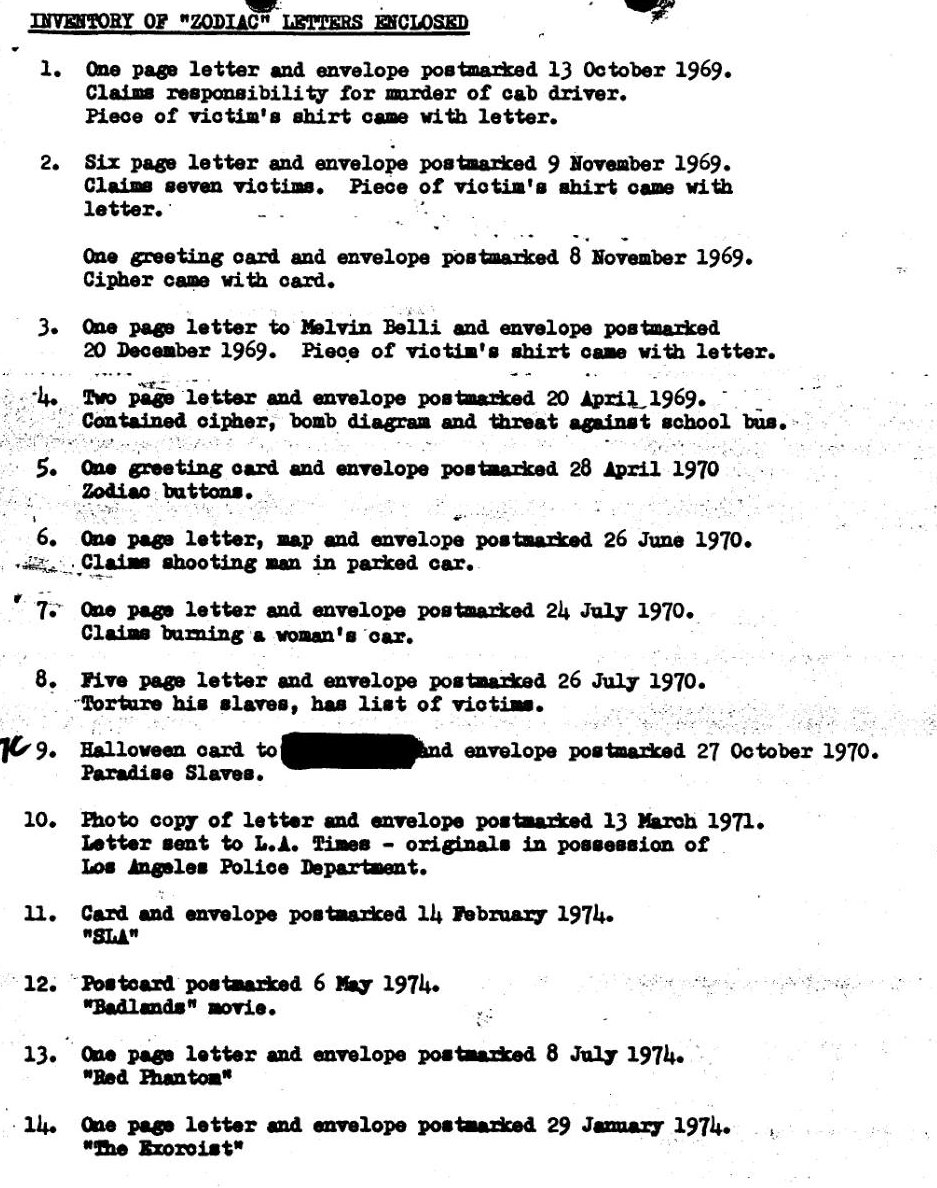
The sequence
| Date | Item | What it contained | Cipher |
|---|---|---|---|
| 31 Jul 1969 | Three letters | One third of a cipher to each of three papers, with unpublished detail from the first two attacks, and a threat to go on a weekend rampage if they were not printed on the front page. | Z408 |
| 4 Aug 1969 | Examiner letter | The first use of the name: “This is the Zodiac speaking.” Taunts that when they crack the cipher they will have him. They cracked it. They did not have him. | — |
| 13 Oct 1969 | Stine letter | Enclosed a swatch of Paul Stine's shirt, and threatened to shoot out the front tyre of a school bus and pick off the children as they came out. | — |
| 8 Nov 1969 | Dripping Pen card | Carried the 340-symbol cipher. Its stamp later produced the partial DNA profile. | Z340 |
| 9 Nov 1969 | Bus Bomb letter | Seven pages. Claimed seven killings, promised to disguise future murders as robberies and accidents, and diagrammed a bomb for a school bus. | — |
| 20 Dec 1969 | Belli letter | To the attorney Melvin Belli, on the anniversary of the first murders, with a second shirt swatch. “Please help me I am drownding.” | — |
| 20 Apr 1970 | “My Name Is” | Thirteen symbols after the words “My name is —”. Denied a police-station bombing, revised the bomb diagram, and started keeping score. | Z13 |
| 28 Apr 1970 | Dragon card | Complained about publicity and demanded people wear Zodiac buttons. | — |
| 26 Jun 1970 | Button letter | A torn Phillips 66 map with a crosshair over Mount Diablo, and a cipher he said would locate a bomb. No bomb was ever found. | Z32 |
| 24 Jul 1970 | Kathleen Johns letter | Claimed the March 1970 abduction of a woman and her baby. | — |
| 26 Jul 1970 | Mikado letter | A parody of a Gilbert and Sullivan song listing tortures, and the only decryption hint he ever gave: the Mount Diablo code concerns radians and inches along the radians. | — |
| 5 Oct 1970 | 13-Hole postcard | Pasted newsprint, thirteen punched holes, and “I'm crackproof.” Investigators judged it probably genuine. | — |
| 27 Oct 1970 | Halloween card | Sent to the reporter Paul Avery. “Peek-a-boo, you are doomed.” Avery began carrying a gun. Its diagonal motif is retrospectively suspected of hinting at the Z340 transposition. | — |
| 13 Mar 1971 | LA Times letter | “I am crack proof.” Claimed credit for Riverside activity and hinted at more victims there. | — |
| 29 Jan 1974 | Exorcist letter | Reviewed the film as a comedy, quoted the Mikado again, and gave a final score. The last letter broadly accepted as genuine. | — |
What he claimed against what is confirmed
He kept a running count. It is worth setting beside the record, not as a scoreboard but as a measurement of how much of what he wrote was true.
| Date | Claimed | Confirmed by then |
|---|---|---|
| Nov 1969 | 7 | 5 |
| Apr 1970 | 10 | 5 |
| Jun 1970 | 12 | 5 |
| Jul 1970 | 13 | 5 |
| Oct 1970 | 14 | 5 |
| Mar 1971 | 17 | 5 |
| Jan 1974 | 37 | 5 |
By his last letter he was claiming more than seven times the confirmed toll. No evidence has ever supported a figure beyond five dead and two survivors.
This bears directly on the ciphers. A man who inflated his victim count sevenfold, denied a bombing he was never linked to, claimed a television caller who turned out to be a psychiatric patient, and announced a buried bomb that was never found, is not a reliable narrator of his own cryptograms. When he wrote “My name is” above thirteen symbols, the prior that it contains his name is weaker than the sentence makes it sound. See Findings.
Disputed and rejected
Several items are contested, and a few are near-certainly not his.
- The Pines card, March 1971, tied to the disappearance of the nurse Donna Lass. The state examiner authenticated it, but a later account has a former investigator admitting a forgery, and the collage material traces to a condominium advertisement published days earlier. Disputed
- The 1974 trio — an SLA letter, a “Badlands” letter signed “A citizen”, and the Red Phantom letter. The FBI file argues against the first. Disputed
- The April 1978 letter was authenticated, then repudiated. The San Francisco police chief publicly doubted it amid a scandal over the lead inspector writing anonymous fan mail about himself. Widely considered a hoax
- Post-1978 items — a 1986 Chronicle letter, a 1987 Vallejo letter, a 1990 Christmas card — are not accepted.
The Riverside precursors
Three items from 1966 and 1967 relate to the murder of Cheri Jo Bates in Riverside: a typed confession mailed to police and a newspaper, a poem written on a desktop, and three notes reading “Bates had to die”. The state handwriting examiner linked the poem and notes to the Zodiac letters in 1970, and the connection was treated as real for fifty years.
In 2021 Riverside police announced that DNA had identified the letters as a teenager's hoax, and formally de-linked the Bates murder from the Zodiac investigation. Several suspect cases leaned on that link and are weaker without it. De-linked 2021
The envelopes
A detail investigators tracked closely: he used doubled six-cent stamps on everything from July 1969 through April 1970 and again in March 1971, switched to single stamps in mid-1970, used Apollo 8 stamps on the October 1970 cards, and correct single eight-cent stamps by 1974. The doubled postage on under-weight envelopes is one of the small behavioural consistencies that helps separate genuine mailings from imitations.