Northern California · 1968–1974 · Open
Five people killed, two survived, and four cryptograms.
Two of those cryptograms have been read. Two have not. This is a working archive of the primary sources, and an original attempt at the two that are left.

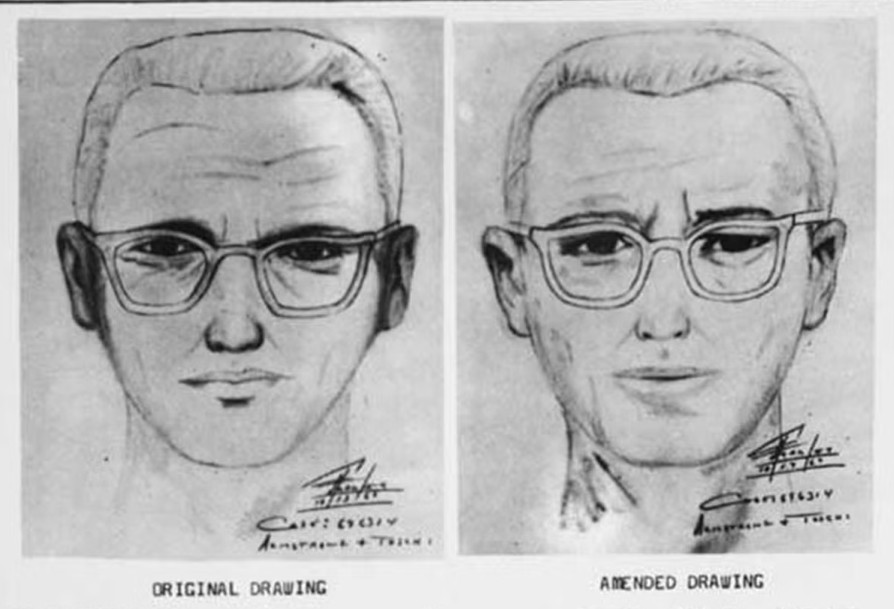
Between December 1968 and October 1969 a man attacked seven people in the counties around San Francisco Bay. Five of them died. He then spent five years writing to newspapers, and four of those letters carried ciphers.
The 408-character cryptogram was broken in a week by a schoolteacher and his wife. The 340-character cryptogram held out for fifty-one years. The remaining two — thirteen characters said to contain his name, and thirty-two said to locate a bomb — have never been read, and the arithmetic in Findings explains why that is not a failure of effort.
This site exists because the material is scattered. The FBI released its Zodiac file in seven parts as scanned PDFs that are painful to read. The transcriptions cryptanalysts rely on live in a handful of repositories. The case history is spread over forums, books of varying reliability, and a small number of careful researcher sites. Here they sit together, with sources named and speculation labelled as speculation.
Start here
| Section | What it holds |
|---|---|
| The Case | The four confirmed attacks, the victims, and the letters, in order, with what is established separated from what is claimed. |
| The Letters | Every mailing in order, what each contained, which are disputed, and the gap between what he claimed and what is confirmed. |
| Suspects | Every named suspect, the evidence for and against each, and the one thing the cipher work can say about them. |
| The Ciphers | All four cryptograms with exact transcriptions, an interactive symbol explorer, and the solved plaintexts. |
| Findings | Original cryptanalysis of Z13 and Z32. Complete answer sets, four hypotheses closed off, and best guesses with the confidence each has earned. |
| Claimed Solutions | Every published solution to the two unsolved ciphers, tested. Most fail; the ones that pass contradict each other. |
| Test a Solution | Check any proposed reading of either unsolved cipher against the constraints the ciphertext actually imposes. |
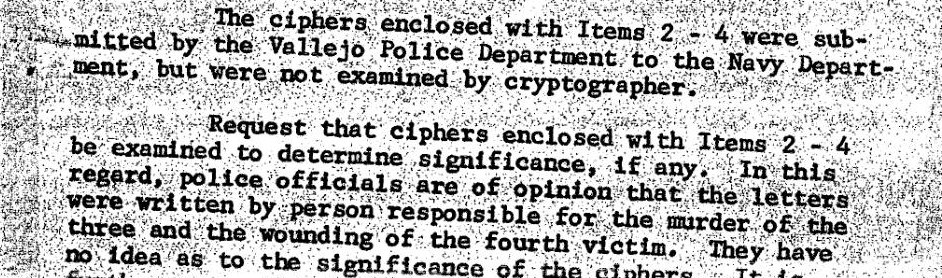
| FBI Files | All seven parts of the Bureau's released file, mirrored and readable in place. |
What is actually new here
Anyone can restate the case. The work in Findings is computational and reproducible, and it settles several questions that usually get argued rather than measured:
- Z32 cannot be a simple substitution cipher. It uses 29 distinct symbols and the alphabet has 26 letters. That is arithmetic, and it invalidates a whole class of proposed solutions.
- Z32 is nevertheless a genuine cipher, not a hoax. Simulating Zodiac's own encipherment method on English text reproduces its repeat structure almost exactly.
- Z13 was not enciphered with a large homophonic key. Its repetition is far above anything his method produces, which means the near-one-to-one hypothesis is the right frame and the answer sets are small enough to write down in full.
- Z13's pattern actively disfavours male names at p = 0.0001 — a problem for every reading that treats it as the author's own name.
- Allowing Zodiac a single encoding error expands the Z13 answer set from 49 candidates to 3,668,004, which is why famous one-error proposals carry no evidential weight.
On how this is written
Five people were murdered and two more were left to survive their injuries. Their names are in The Case, given the same typographic weight as everything else on this site rather than being reduced to a body count. There are no countdown timers here, no “kill score” tiles, and no atmospheric styling borrowed from horror. The documents are unsettling enough on their own.
Where a claim is disputed, it is marked disputed. Where something is asserted by a particular researcher rather than established, that researcher is named. Where the honest answer is that nobody knows, that is what it says.